
Relevance AI
ActiveSpecialist AI Agents for Every Task | Relevance AI
At a glance
Relevance AI is an enterprise-grade AI workforce platform designed to help modern businesses and any forward-thinking AI agency build, orchestrate, and supervise autonomous teams of software agents. Rather than requiring technical teams to assemble piecemeal infrastructure across standalone LLM routers, execution queues, and tracing platforms, Relevance AI provides a unified operating system from visual creation to governance. The system enables organizations to decouple operational growth from headcount by delegating complex, multi-step knowledge tasks—such as inbound lead enrichment, technical research, and contract reviews—to specialized digital workers. Domain specialists across sales, customer operations, and marketing can deploy production-ready agent teams without writing extensive backend code. By combining low-code visual builders with enterprise security controls like role-based access and SOC 2 Type II compliance, Relevance AI bridges the gap between rapid prototyping and production reliability.
How it works
- Workflow Discovery & Scoping: Teams engage with Invent 2.0 or map target workflows manually, identifying repetitive knowledge tasks across customer operations, lead generation, or data synthesis.
- Agent Assembly & Context Layer Configuration: Builders construct specialized agents on the Workforce canvas, defining distinct system instructions, connecting required SaaS tools via the integration library, and linking shared corporate knowledge bases.
- Pre-Production Benchmark Evaluation: The configured agent team runs against automated evaluation suites (Evals) to score output accuracy, SLA adherence, and formatting precision against strict organizational standards.
- Approval Gate & Security Policy Setup: Administrators enforce governance controls by configuring role-based access, data residency parameters, and automated pause triggers for actions exceeding predefined operational thresholds.
- Deployment & Centralized AgentOS Supervision: Production agents run autonomously across scheduled triggers or live webhooks, while operators monitor real-time execution logs, cost-per-task metrics, and performance analytics via AgentOS.
Features and capabilities
Autonomous Agent Orchestration
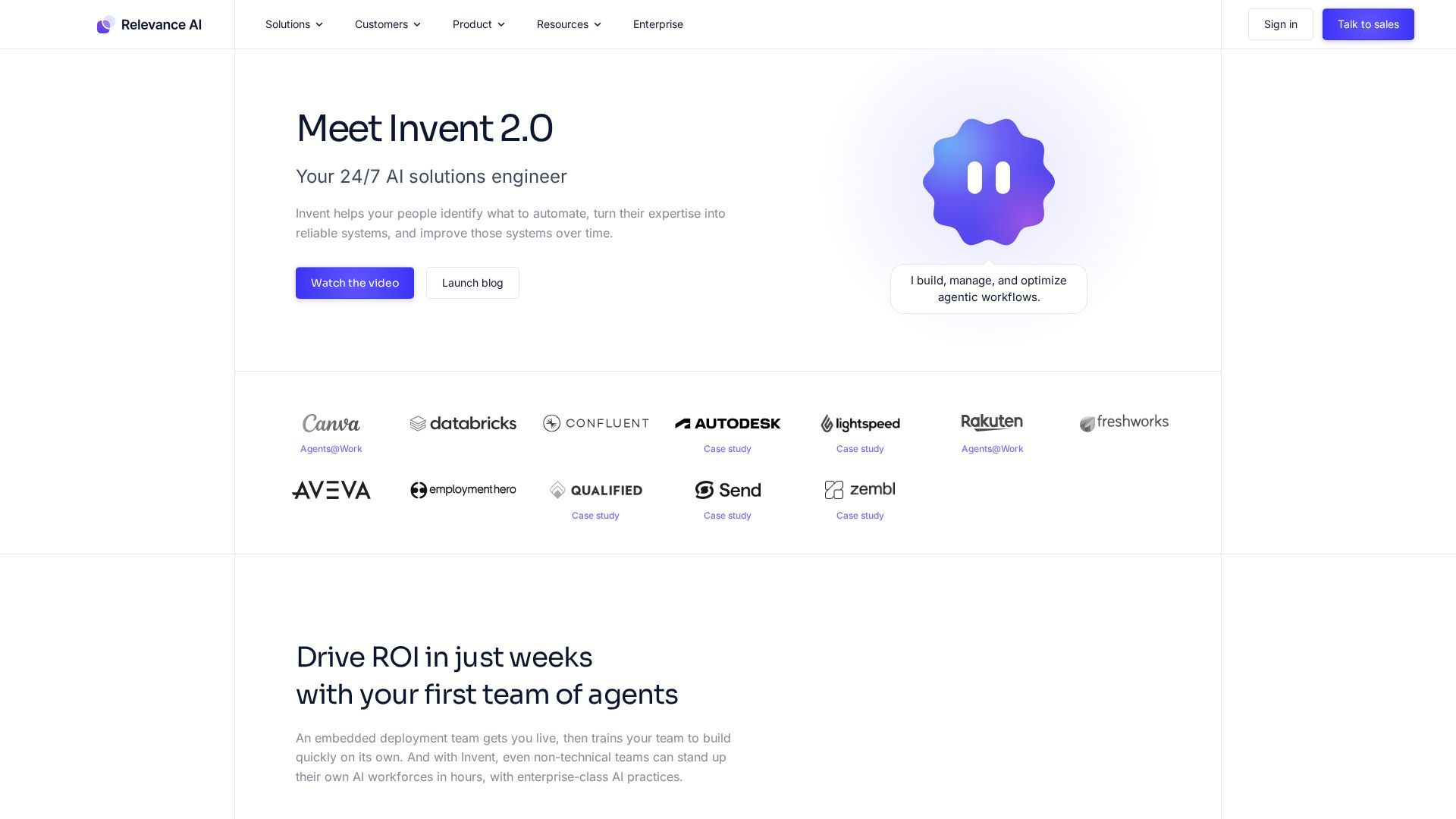
- Invent 2.0 AI Solutions Engineer: An automated agent that interviews your team, identifies automation opportunities, scopes workflows, and generates specialized agent teams automatically.
- Workforce Visual Canvas: A drag-and-drop orchestration canvas allowing builders to design hierarchical delegations and multi-agent coordination without code.
- AgentOS Management Hub: Centralized command center providing scheduling, performance monitoring, and team-wide governance.
Production Governance & Evals
- Agent Evals Benchmarking: Standardized quality benchmarks that score agent prompts, outputs, and SLA adherence before deploying to production.
- Human-in-the-Loop Approval Gates: Threshold-based safeguards that pause high-stakes actions (such as high-value refunds or CRM stage updates) for manual verification.
- Enterprise Security & Compliance: SOC 2 Type II certified, GDPR compliant, SSO/SAML, granular RBAC, and strict data residency guarantees with zero model training on client data.
Full-Stack Tooling & MCP Gateway
- 2,000+ Native Integrations: Seamless connectivity to standard B2B SaaS tools, databases, and communication platforms.
- Model Context Protocol (MCP) Gateway: Centralized gateway to securely connect agents with local enterprise databases, code repositories, and external tools under unified permission boundaries.
- Full Execution Tracing & Live Monitoring: Real-time visibility into prompt inputs, tool calls, latency, errors, and task-level cost breakdowns across all active workflows.
Screenshots
See Relevance AI in action
Screenshots are supplied by the agent's own listing.
Use cases
- AI Automation Agencies (AAAs) Building Client SolutionsWho it's for: Agency founders, AI consultants, and digital transformation service providers. Practical value: Agencies can package and deliver customized, autonomous operations suites to client accounts in days rather than months. Instead of engineering proprietary backend orchestration stacks with custom databases and queue managers, agencies configure white-glove multi-agent systems on Relevance AI, drastically lowering delivery overhead and technical maintenance costs.
- B2B Sales & Revenue Operations (RevOps)Who it's for: Sales development leaders, RevOps managers, and growth marketers. Practical value: Relevance AI deploys interconnected agent chains that research inbound leads, extract fresh technographic signals, synthesize pre-meeting briefing documents for account executives, and automatically update CRM records with meeting summaries and action items, eliminating manual pipeline administration.
- High-Volume Customer Success & Support OperationsWho it's for: Customer support directors, operational leads, and tier-1 support teams. Practical value: Digital agents resolve complex, multi-system support tickets around the clock by referencing knowledge repositories and checking backend system status. Routine resolutions complete autonomously, while sensitive operations—such as balance adjustments or contract modifications—route directly through human approval gates for verification.
Frequently asked questions
- Is Relevance AI suitable for building an AI automation agency (AAA)?
- Yes, Relevance AI is widely adopted by AI automation agencies because it provides a complete client delivery stack—including a visual multi-agent canvas, over 2,000 integrations, and automated evaluation suites—allowing agencies to deploy sophisticated B2B automations without building custom backend infrastructure from scratch.
- How does Relevance AI price its platform?
- Relevance AI prices its enterprise platform via custom sales-led contracts based on workload scale. Usage is divided into Platform Actions (in-house execution and tool orchestration) and Vendor Credits (third-party LLM inference tokens), ensuring businesses have clear line-item visibility over their infrastructure spend.
- Does Relevance AI require coding knowledge to build agents?
- No, core agent creation and workforce orchestration are handled through visual, no-code builders and conversational interfaces like Invent 2.0. However, technical teams retain the flexibility to add custom code blocks, integrate custom APIs, and utilize the Model Context Protocol (MCP) for advanced use cases.
- How does Relevance AI handle enterprise data privacy and governance?
- Relevance AI enforces enterprise data protection through SOC 2 Type II certification, GDPR compliance, role-based access control (RBAC), single sign-on (SSO/SAML), and data residency guarantees, while committing to never train foundation models on proprietary client data.