
Zapier
ActiveBuild and manage AI teammates that take action across 9,000+ apps.
At a glance
Zapier Agents is an AI orchestration platform that enables teams to build, customize, and deploy autonomous digital teammates across more than 9,000 connected applications. By combining natural language instructions with Zapier's extensive ecosystem of triggers and actions, Zapier Agents allows users to delegate multi-step administrative, marketing, sales, and operational tasks without writing code. Through the Zapier Model Context Protocol (MCP) and Next Gen Zaps featuring Fluid Determinism, the platform connects frontier AI models like Claude, ChatGPT, and Cursor directly into corporate software stacks while maintaining centralized security, role-based access controls, and execution audit logging.
How it works
- Configure your AI agent using conversational Copilot guidance or natural-language system instructions that define its role, persona, and core business objective.
- Equip the agent with company context by uploading internal documents or connecting live knowledge sources, URLs, and cloud storage repositories.
- Assign granular execution tools and action permissions selected from Zapier's catalog of 9,000+ connected business applications.
- Deploy your agent to run autonomously in the background, collaborate with teammates in chat, or connect externally via Model Context Protocol (MCP) to Claude, ChatGPT, and Cursor.
Features and capabilities
Autonomous Agent Creation & Zapier Copilot
- Natural-language agent configuration using conversational Copilot guidance
- Direct synchronization with live internal knowledge bases, URLs, and static documents
- Autonomous decision-making loops equipped with web browsing and cross-application tool execution
Zapier MCP & Cross-Platform Context Layer
- Secure Model Context Protocol (MCP) server integration for Claude, ChatGPT, and Cursor
- Granular per-seat permission boundaries governing app actions and credential exposure
- Zero API key exposure for connected team members across 230+ external AI platforms
Next Gen Zaps & Enterprise Governance
- Fluid Determinism engine that optimizes token spending by converting repeated steps to deterministic runs
- Self-healing error detection with autonomous AI manager agents fixing broken workflow runs
- Enterprise compliance suite meeting SOC 2 Type II, SOC 3, GDPR, and CCPA standards with centralized audit logs
Screenshots
See Zapier in action
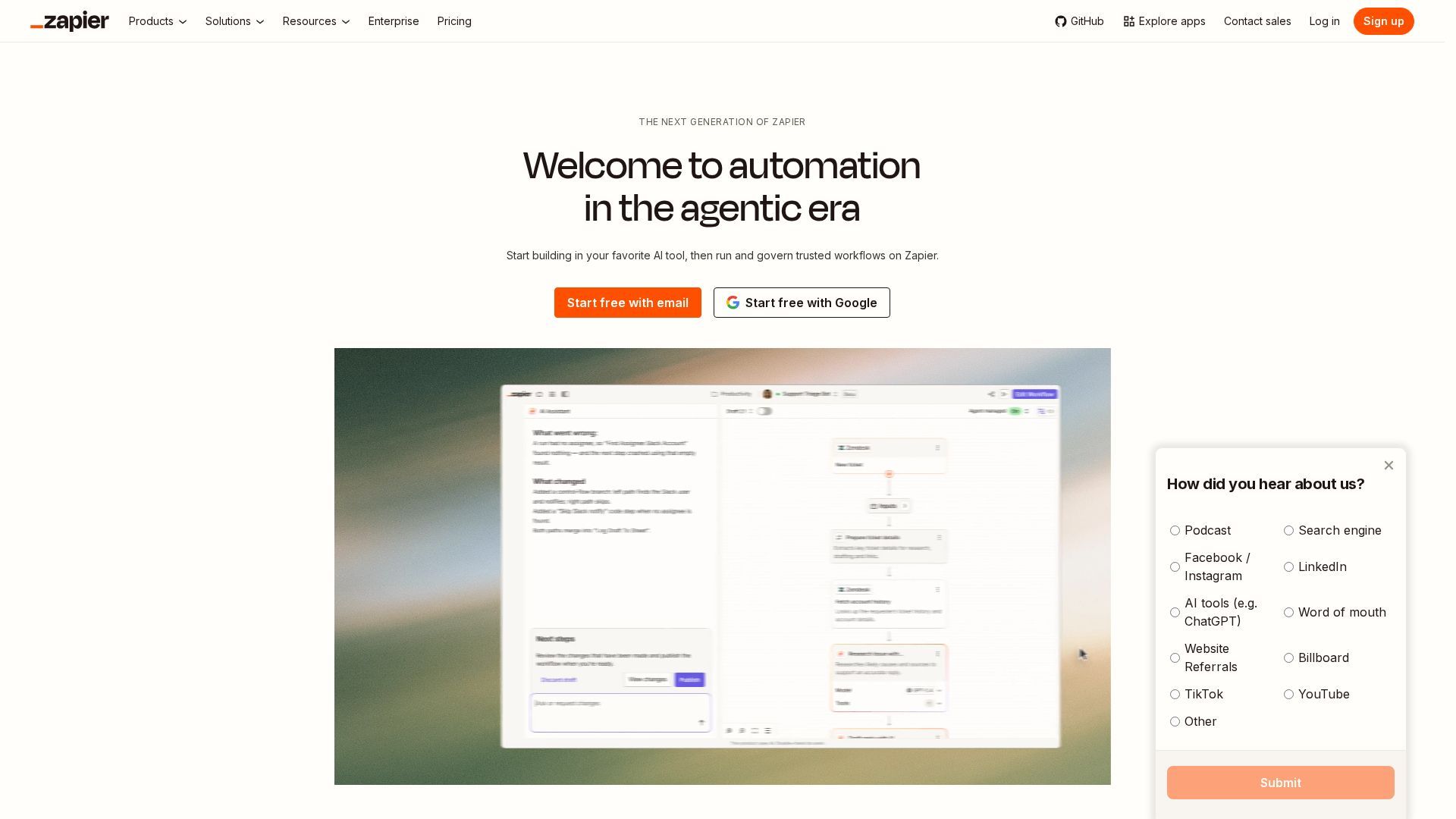
Screenshots are supplied by the agent's own listing.
Use cases
- Automated Meeting Preparation & Attendee DossiersWho it's for: Account executives, customer success managers, and sales leaders. Practical value: Automatically researches upcoming calendar attendees across CRM systems, LinkedIn, and internal documents to compile actionable briefing dossiers before every client meeting.
- Enterprise Inbound Lead Qualification & CRM RoutingWho it's for: Growth marketing teams, sales operations, and revenue teams. Practical value: Evaluates incoming form submissions, enriches company profiles against external databases, and routes high-priority prospects directly into CRM pipelines with contextual notes.
- Operational Ticket Intake & Deterministic TriageWho it's for: IT service desks, customer support leads, and operations managers. Practical value: Parses inbound support tickets, matches issue categories against internal documentation, and executes routine account updates or escalations automatically.
Frequently asked questions
- What is Zapier Agents and how does it work?
- Zapier Agents is an AI automation workspace where users create digital assistants that execute multi-step business tasks across 9,000+ web applications. Powered by natural language prompting and connected knowledge sources, agents can browse the web, retrieve data, and autonomously perform actions in third-party tools based on defined business rules.
- What is the difference between Zapier Agents and standard Zaps?
- Standard Zaps follow a strict, linear if-this-then-that trigger-and-action sequence. In contrast, Zapier Agents use artificial intelligence to reason through unstructured input, decide which tools to invoke dynamically, and adapt to non-standard scenarios before executing final deterministic actions.
- How does Zapier secure enterprise data and prevent unintended agent actions?
- Zapier provides enterprise-grade governance including SOC 2 Type II and GDPR compliance, SAML SSO, user provisioning (SCIM), and centralized admin controls. Administrators can restrict specific app connections, enforce action-level permissions, and review complete execution audit logs for every agent interaction.
- When should businesses choose Diaflow over Zapier Agents?
- While Zapier Agents excels at broad connectivity across thousands of commercial SaaS apps, Diaflow is purpose-built for businesses requiring complex, custom multi-step agentic workflows with deeply integrated business logic, dedicated custom UI components, and tailored operational execution loops.